Real browsing, real pages
Tabs, bookmarks, history, and desktop mode — a full browser experience powered by the same web engine you already trust.
 Veil
Veil
Veil is a privacy-focused browser that observes advertising and analytics activity in plain English — without blocking the web. Understand the signals. Keep control on your device.

Most browsers hide tracker activity behind the scenes. Veil makes it visible — so you can decide what matters, what feels excessive, and what you want to watch over time.
Tabs, bookmarks, history, and desktop mode — a full browser experience powered by the same web engine you already trust.
Tap Report to see tracker signals on the current page — who they likely belong to, what role they play, and how heavy the page feels.
History, tracker logs, and insights live on your device. Veil does not send your browsing data to our servers.
Veil connects signals across pages in a session so you can see pressure themes — shopping, news, identity, and more — labeled as inference, not proof.
With your consent, scan the visible screen to read ad labels and on-page content that network logs alone might miss.
Veil’s signature dark theme, plus presets and custom accents — because transparency tools should feel as considered as the browser itself.
Privacy-aware web search that rewards quieter sites. Higher Veil Score means lower tracking exposure — scored on-device from what you’ve actually browsed.
Two lenses on the same session — what is happening right now on this page, and what patterns are building across your browsing.
Immediate tracker signals on the page you are viewing: network requests, scripts, pixels, cookies, and storage writes — mapped to known vendors where possible.
Session insights that look across sites for recurring themes — useful when a single page looks quiet but the overall session feels targeted.
Home, Veil Report, and the scans behind sponsored posts — real screens from the iOS app.
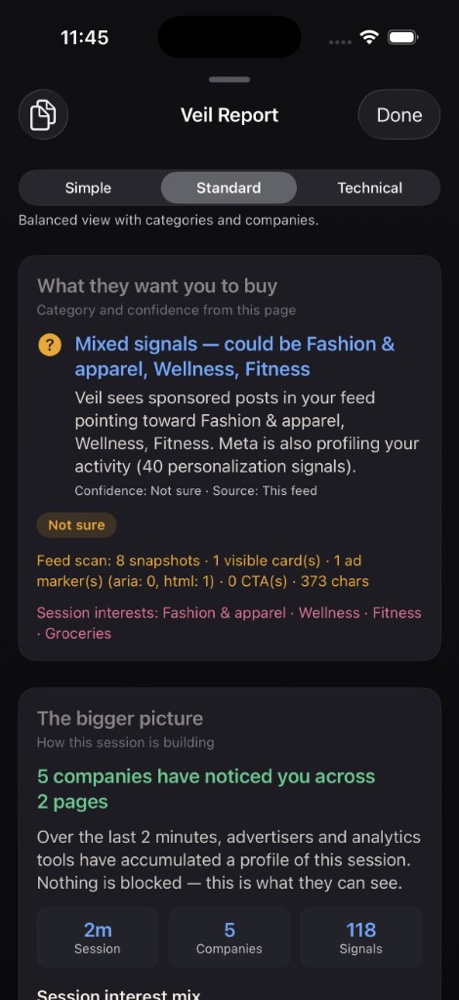
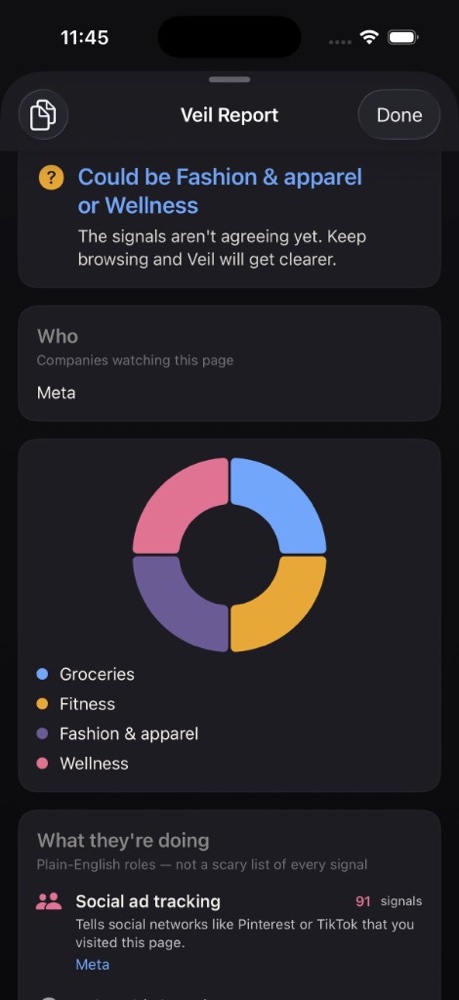
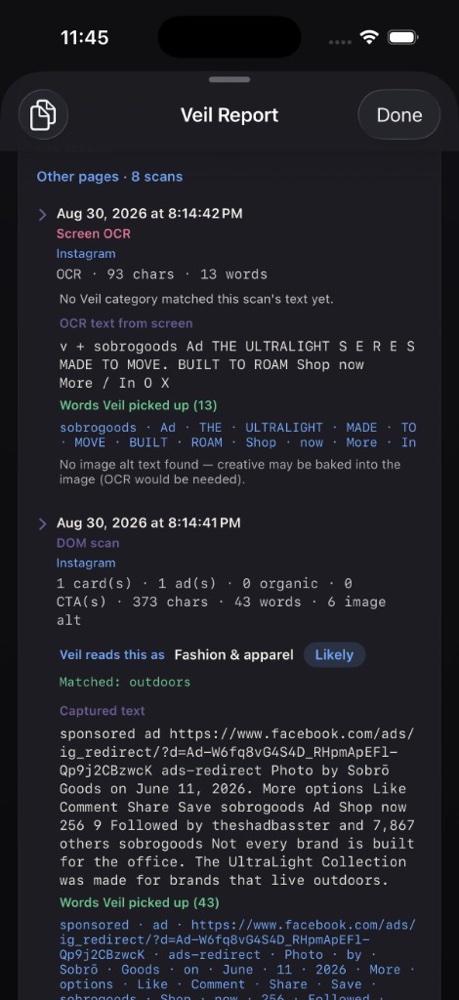
We also need to reward sites that don’t profiteer from collecting our data. Veil Search ranks the open web with privacy-aware scores — built from tracking you’ve actually observed in Veil, stored only on your iPhone.
Ad blockers hide the problem. Veil Search surfaces destinations with lower tracking exposure — a Veil Score where higher means less observed surveillance pressure, not just a raw tracker count.
Veil does not send or receive your browsing or score data. Privacy ratings live on this device so search can get smarter the more you browse — without building a Veil cloud profile.
Veil is named for what hides the machinery of the world — the comfortable surface we browse through every day. Two old ideas shaped it: Schopenhauer’s account of appearance, wanting, and suffering — and Odin’s ravens, sent out each morning to see what the world is doing.
“The world is my representation.” — Arthur Schopenhauer, The World as Will and Representation, Book I
Schopenhauer begins here: what we meet first is not the world-in-itself, but a representation — a picture shaped for a perceiver. A news article, a product page, a calm-looking feed: each is a surface assembled for your senses. The web is almost nothing but representations — and for most browsers, what supports that surface stays invisible.
Beneath every representation, Schopenhauer argued, lies the Will — not your personal preference, but a blind, restless striving at the root of life: to want, to pursue, to reach for the next thing. In Book II of the same work, the title names both halves: appearance and will. The page you see is the mask; wanting is the engine under it.
The modern web runs on that engine. Retargeting, personalization, auction-driven ads, and session profiling are not neutral plumbing — they are machinery built to stir and steer wanting. Trackers measure appetite. Ad networks bid on it. The representation stays pleasant; the will-work happens out of sight.
For Schopenhauer, suffering follows from will itself. To want is to be unsatisfied: the moment one desire is met, another rises. Life becomes a pendulum between craving and boredom — and the more forces learn to pull your will, the harder it is to see you are being pulled at all.
That is not abstract on the internet. It is the shopping ad that follows you for days, the identity pitch that arrives after one search, the session that slowly narrows toward pressure themes — commerce, status, fear — until the feed feels less like choice and more like appetite. Schopenhauer would not call this a moral failure on your part. He would call it will, working through a veil you were never shown.
He borrowed Maya from Indian philosophy: the veil of illusion that makes the world look finished when it is not. Schopenhauer’s own response leaned toward aesthetic contemplation and the quieting of will — seeing clearly enough that striving loosens its grip. Veil takes a parallel path, not a religious one: look through the veil first. See the representation and the will-work beneath it — then decide what you owe either of them.
Veil does not block the web, because blocking only swaps one blindfold for another — you still would not know what was trying to reach you. Instead, Veil makes the underworld visible:
Suffering, for Schopenhauer, began in unseen wanting. Veil’s job is narrower and practical: strip the unseen part away. Not to end desire — that is yours — but to let you browse the representation knowing who is speaking to your will, and when.
Huginn and Muninn
fly over the earth each day.
I fear for Huginn, lest he not return —
yet more for Muninn. — Grímnismál (Poetic Edda), stanza 20 · translation adapted
Odin’s myth completes the picture. Each dawn he sends two ravens across the world — not to fight what they find, but to return with news. Huginn (Thought) and Muninn (Memory) are watchers. Veil is built in that spirit.
Thought · Right now
The Veil Report on the page in front of you — tracker signals, ad pressure, and roles as they happen. Schopenhauer’s present tense: what is stirring your will right now.
Memory · The session
History and session patterns — what repeats across sites when a single page looks innocent. Schopenhauer’s memory of wanting: the arc of pressure, not just the moment.
Appearance, will, suffering — then the watcher who returns. The raven on our icon is that watcher: thought and memory on your shoulder, so you can see the veil and the wanting beneath it, and browse on your own terms.
Veil is currently available for iPhone and iPad only (iOS 17+). Based on adoption, we plan to explore Android and desktop next — so the same transparency story can follow you wherever you browse.
“Veil shows you what advertisers and trackers are doing — nothing is blocked.”
Veil Browser+ is live for iPhone and iPad (iOS 17+). Built for people who want to understand the web, not just browse through it — Android and desktop if enough of you ask for them.
Download on the App Store